

Jumping Ship
Celebrating Croatian Independence Day in San Pedro

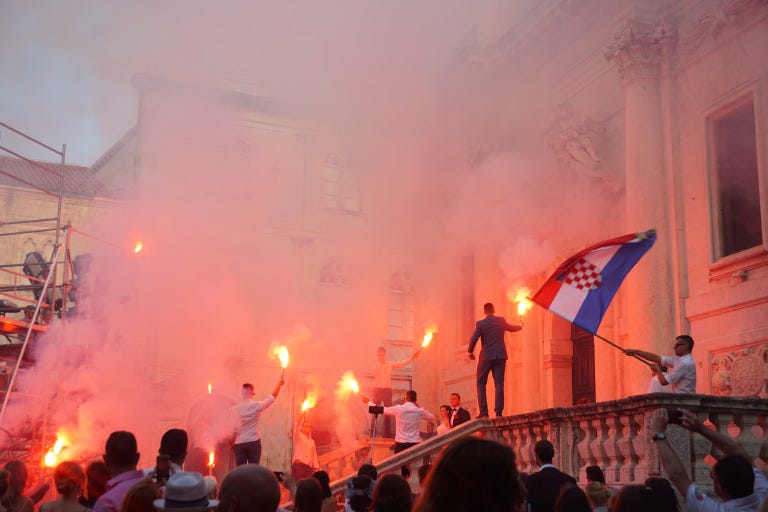
This Sunday, the Croatian community in Los Angeles holds its Independence Day celebration in San Pedro. There will be good food and music, Croatian beer, and community. It is a celebration of a culture that shouldn’t have survived. Croatians spent millennia as the object of empire, with intermittent periods of freedom.
Then the fall of the Austro-Hungarian Empire after World War I redrew borders, collapsed local economies, and scattered Croatians across the world.
My grandfather left his home, Tribunj, a small village on the coast near Šibenik. He was the oldest of three boys, and there was not enough food to feed them all. He was 13 years old, built like a brick shithouse, and looked like a movie star. He sailed around the world as a kitchen boy on a fishing boat for three years, until they made port in North Carolina, his first glimpse of America.
He had been told that there were families settled near Los Angeles, where the fishing was good, and the Pacific reminded them of the Adriatic back home. When he walked into port in North Carolina, he kept walking. When I heard this story as a child, the old-timers called it jumping ship.” I spent years wondering why he had to jump. No one said I was a particularly bright child.
The details of his journey were always murky, and somehow became murkier every time someone told the story.
What I could piece together was that he took a train bound for Los Angeles, met a woman on board, and made a detour in Texas. I don’t know, but I have imagined she was a much older woman, maybe a widow, who brought him home, only to be rejected by her family. All we know for certain is that he ends up back on the westbound rails and arrives at Union Station sometime in the early forties, in the shadow of Executive Order 9066 and the forced removal of the Japanese-American fishing community from Terminal Island.
He found a place that was as close as he hoped to get to home again. In San Pedro, he found a community that shared a common language and culture, a familiar climate, and a fishing fleet that provided work. Nearly every third person he met had come from the villages and islands near his own.
He found work in a kitchen and kept his head down until he was arrested for immigration and held in detention on Terminal Island. He could see the boats and the docks from the prison yard. They sorted the men by ethnicity, and he was housed with the other Croatians, where he took charge of cooking the meals.
He got out when he married my grandmother, giving him legal status, and eventually became a Citizen. He opened a café on Beacon Street with twelve stools, and he stayed in San Pedro for the rest of his life.
He lived long enough to see the Croatian-American Club established in 1958, and long enough to watch the green bridge rise over the harbor in 1963, named for Vincent Thomas, born Tomašević, the state assemblyman who fought for years to make sure it got built.
My grandfather, Ante Perkov, also lived long enough to return home many times and to see an independent Croatia declared in 1990, after the collapse of the last regime to hold it. The nineties feel both recent and ancient, much like Croatia itself. At 36 years old, the country is still developing, rising from the ruins of Empires as old as Rome.
This weekend in San Pedro, thousands will come to celebrate this little country of fewer than four million people, roughly the population of the city of Los Angeles. The Croatian diaspora exceeds that number, with over a million descendants living in the United States alone.
Have the ćevapčići and a Karlovačko and listen to the old songs. Watch history continue to unfold.
xAP
Samo jaki opstaju 💪🏼 🇭🇷
Nice one Ante!
Sounds so much like Ralph’s father starting fishing at age 16 in Africa and all over ! Ended in San Pedro and rest is History! On u tube a movie called the smell of money ! It’s excellent all about San Pedro fishing ! ❌⭕️❤️