

Eighty Places

One of the great pleasures of having written over 200 Substack pieces for you all is that when the calendar rolls around, I get to revisit the memories I shared in my writing and see what I could have done better. The great poet of the 1990s, Adam Duritz, reminds us that “the price of a memory is the memory of the sorrow it brings”.
My father would have been 80 last Sunday, which is why I wrote this piece two years ago. I added some things. The rest holds up enough to make it worth your time.
My dad was a hot dog guy and a chili dog aficionado.
Los Angeles is a chili dog city. It's food that doesn't care who you are, where you're from, or what you drive. A chili dog is a chili dog at Pink's and a chili dog at a stand on Crenshaw or a chili dog at the Coliseum before kickoff. The guy in the Range Rover and the guy on the bus are eating the same thing.
It's a hand meal, like a sandwich, but something different. German immigrants brought them to America, but they have come to embody the egalitarian freedom of this place. Meat, fat, and spices are ground together like sausage but emulsified into something unto itself, just like Americans.
They are so American that to be elected to high office in this country, you must eat them in some public display of patriotism. There is a brilliant web page by Andrew Heaton dedicated to documenting this political phenomenon. It helps that hot dogs are served everywhere, from street carts to country clubs, and they're essentially the same meal.
Regardless of age or generation, many Americans link hot dogs to some simpler time in our lives. At least, I know I do. I remember roasting Oscar Meyers at the ends of wire hangers in the Bolsa Chica Beach fire pits in the 1980s and watching my father turn dozens of them over on a Weber Kettle Grill in our backyard. That man loved hot dogs. And he was not discerning about it. He ate gas-station dogs, chili dogs from a stand on Crenshaw Boulevard, and LA danger dogs, wrapped in bacon and cooked on baking sheets set on cinder blocks over Sternos.
One year, for my mother's 60-something birthday, we indulged in an extravagant meal. We sat at the chef's table inside the Bel Air Hotel's kitchen and enjoyed an elegant five-course meal prepared in front of our eyes. We traveled together, our tribe, in my father's 15-passenger Ford van because we fancy like that.
As a general rule, the more elevated the meal, the smaller the portion served. So, of course, we detoured on our way home to Pink's. We braved the wait in our city clothes and enjoyed our second evening meal on the Harbor Freeway.
Of course, Pink's is Los Angeles legend. They have been serving up snappy Hoffy brand links since 1939. I’m not a snappy guy, but there is no arguing with success.
After the War, LA experienced a hot dog renaissance.
A lovely little chain of hot dog stands was born in 1946 at Muscle Beach in Venice. Hot Dog On A Stick became known as much for the iconic striped uniforms of its workers as for its batter-dipped and fried dogs. The LA chain grew to 45 locations at its peak. During the mall life of the 1980s, the Hot Dog On A Stick served as a refuge for my father on the rare occasion he accompanied us to the mall. I snuck off with him, awe-struck by the sheer tallness of the high school girls working behind the counter in the food court.
John Galardi opened the first hot dog restaurant to become a national chain on July 3, 1961, on Pacific Coast Highway in Wilmington. Der Wienerschnitzel. His wife found the name in a cookbook. Galardi told her nobody in their right mind would call a company Wienerschnitzel. The family oversees over 300 locations today.
My parents and godparents were season-ticket holders for USC football throughout my childhood, and hot dogs were an integral part of our game-day experience. The Coliseum dogs were unremarkably delicious. Our family lore includes my Dad arriving early to a game to see the Trojans warm up and enjoying 16 Coliseum dogs before kickoff.
When my father was in his 60s, he was diagnosed with Alzheimer's disease. Alzheimer's has a strange effect on time, shortening it while stretching it out simultaneously. Good days slip away in scarcity, and bad days repeat. As with any disease, the reality of mortality has a wide blast radius.
My brother-in-law and I confronted those fading days by taking my dad on a hot dog run for his birthday. A hot dog run is to map out five or so of the best hot dog stands or restaurants we could find and eat our way around Los Angeles. We've been to the Valley, throughout Downtown, and everywhere in between. We probably taste-tested 80 LA hot dogs before my father's 70th birthday.
Der Wienerschnitzel won.
My father suspected it for years. The rest of the list was research to confirm what he already knew, which is a perfectly reasonable way to spend a decade with your son. The chili dog is soft. That's the thing. It's soft, and it settles into the bun, and it costs three dollars, and it doesn't ask anything of you. It is the right amount of good-bad. The chili is not trying to win a James Beard Award. The bun is not brioche. Nobody is telling you about the provenance of the beef. It's just there, the same as it was in 1961, the same as it was when my father was young, and the days were bright and in front of him.
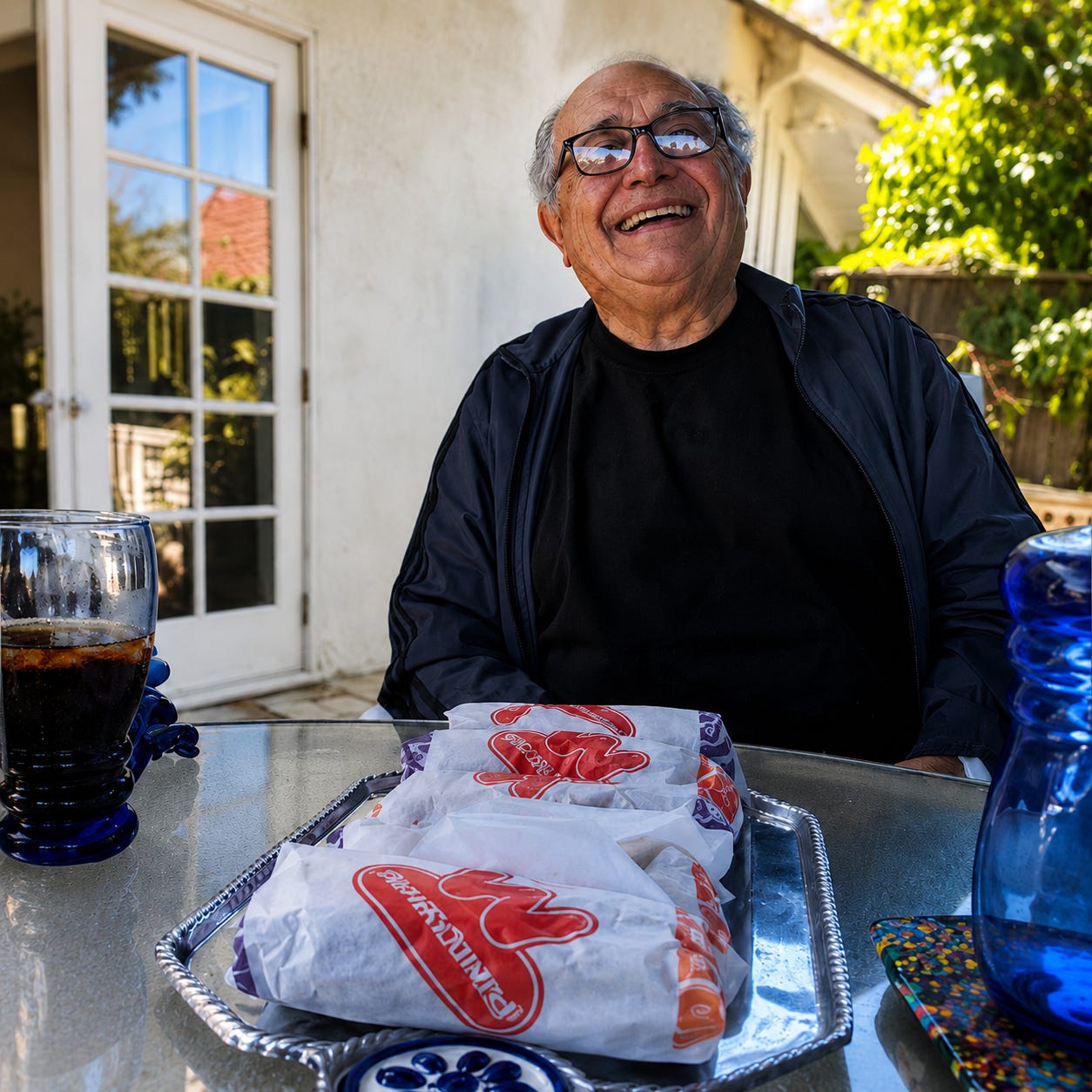
A friend sent me a photo this week from my father's 70th birthday party. My dad is sitting in front of a silver tray of Der Wienerschnitzel chili dogs.
He would have been 80 last Sunday.
He passed away a few months after his 75th birthday. Do not mourn my father. He left life as he lived it, on his own terms.
xAP