

Poolside Fairytales
Reinvention in the Digital Age

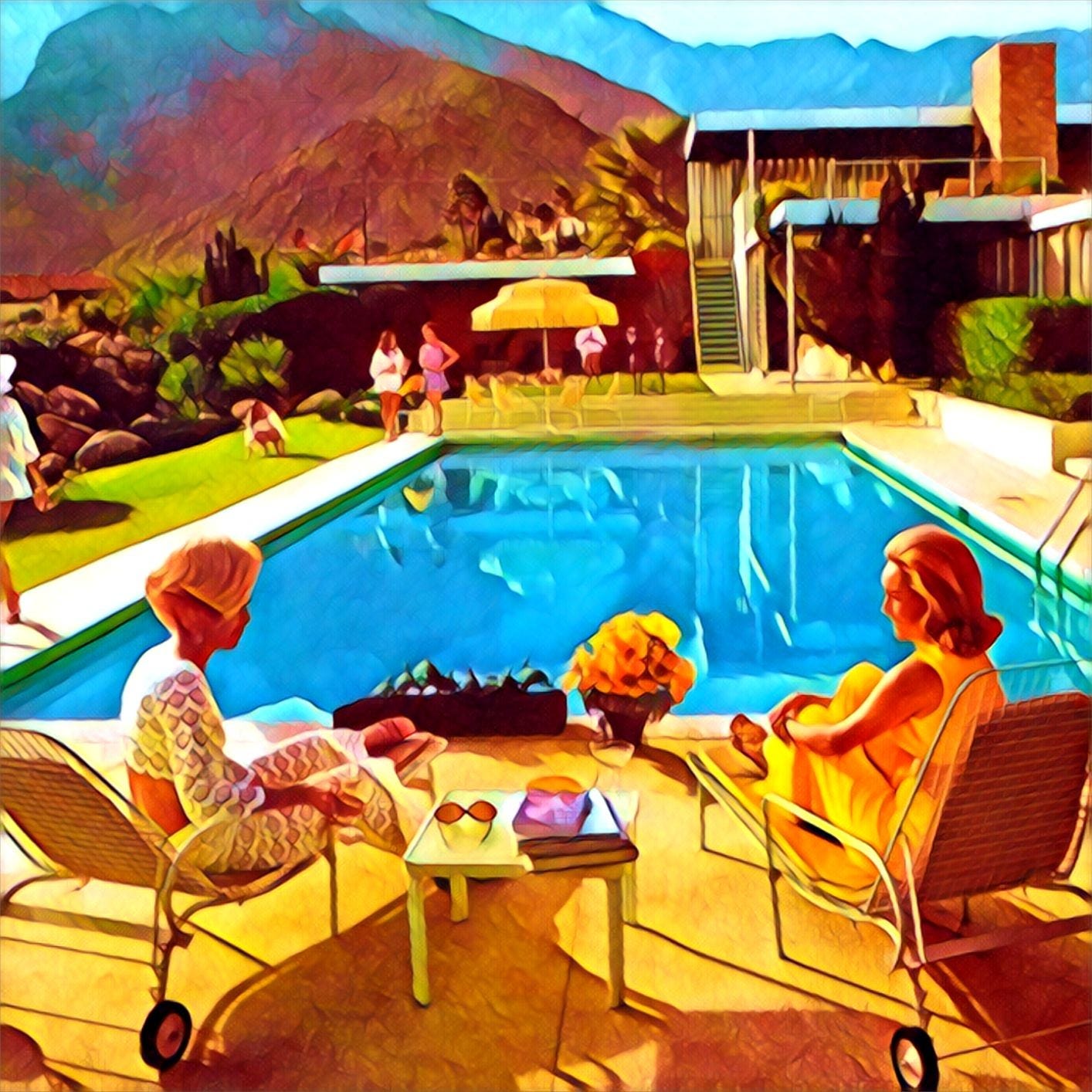
In contrast with my increasingly curmudgeonly views on modern living, I genuinely enjoy the interconnectivity technology has brought us. I am only able to connect with all of you because of technology. Of course, we will lose things dear to us as technology advances, but alas, there is always a price for progress. Amongst those is our capacity to reinvent ourselves, a theme exemplified not just in literature, as in Fitzgerald’s story of Jay Gatsby, but vividly in real lives like those of Slim Aarons and Michael Romanoff.
Slim Aarons, born George Allen Aarons, relocated to Los Angeles after serving as a combat photographer in World War II. Aarons had a difficult upbringing in New York’s Lower East Side, a far cry from the glamorous world he would later document. His family only discovered his true origin story after his death.
Aarons became the photographer of record for the world’s elite, possibly because of a photograph he took in 1957 at Romanoff's in Los Angeles, titled Kings of Hollywood, featuring icons Clark Gable, Van Heflin, Gary Cooper, and James Stewart standing at the bar of the Crown Room at Romanoff's on New Year's Eve. Michael Romanoff, a master of reinvention, ran this restaurant and lounge. Born Hershel Geguzin, Romanoff crafted an identity as “Prince Michael Dimitri Alexandrovich Obolensky-Romanoff," purportedly a nephew of Tsar Nicholas II. The real Prince had died during the Russian Revolution, but it did not matter. The more strands Romanoff weaved into his background, the greater his mystique. Hollywood, the reinvention factory, allowed Romanoff to mingle with stars and make them a part of his story.
Like Romanoff, Aarons spent his career around “attractive people in attractive settings” because he said, “I believe in fairytales.” His work jet-setted him around the globe, photographing celebrities who welcomed him as one of their own as they recognized his ability to portray their world without betrayal.
The resurgence of Slim Aarons’ work in the Instagram era underlines the timeless appeal of his photographs, such as the 1970 Poolside Gossip, which captures leisure at the Richard Neutra-designed Kaufmann House. The photograph embodies mid-century cool and seemingly effortless glamour. By intertwining himself with his subjects, Aarons reinvented how celebrity was perceived.
But in the digital era, where our footprints are nearly indelible, and every action can be archived, is reinvention still possible?
In times gone by, figures like Slim Aarons and Michael Romanoff could craft their identities almost at will, their pasts obscured by the lack of a persistent digital record. Today, while our pasts may not be shed or easily rewritten, the platforms that might lock us into a particular image of ourselves also offer unprecedented opportunities for self-expression and reinvention.
I read an excellent article about Slim Aarons by Nick Foulkes in The Rake. The article centers around Aarons’s books of photography and concludes with a dedication in one of those books:
Dear Jonathan, Remember. It’s all Bullshit. Best as Always, Slim
xAP
I’m still trying to figure out out AI! It’s all a mystery to me ! The Red Onion has a lot of old movie buff pictures ! ❌⭕️❤️💯👏