

The El Cholo Feeling
Los Angeles Letter

Growing up in Los Angeles in the 1980s, you become desensitized to change. The lot where you once played Evil Knievel, jumping your BMX over friends brave enough to lie beside a cinderblock ramp, becomes an apartment complex. Across the street, a beloved restaurant is reduced to rubble and never rebuilt. Ashes to ashes. You learn that nothing lasts. What was once called Gen X apathy is something else - confidence that comes from believing in the only true sentence: “This too shall pass.”
In the face of this redestruction and the fatalism of the Cold War, we sought dependabilities. For our family, that meant college football Saturdays at the Coliseum supporting the USC Trojans, big Mexican dinners that followed, free-flowing drinks like Roy Rogers and Shirley Temples, and checks paid by our fathers in cash. There were a lot of us back then, two families and more friends, one tribe.
Sometime in the 1980s we sat on the porch in front of the El Cholo restaurant on a scrubby patch of Western Avenue. The wait at El Cholo was always long, especially after a USC game. But nobody minded back then. That’s how you knew it was good. We watched my mother and Godmother disappear into a fortune teller’s house that occupied the lot on the other side of the restaurant’s driveway; I imagine there was some neon sign in the window that beckoned them.
I don’t know what fortunes they were told, and neither seems to remember, but maybe that’s the point. I’ve been to fortune tellers worldwide, from LA to Jackson Square in New Orleans, to the witches market in La Paz, Bolivia. The answers were always the same -
"You’ll lose something you thought you needed."
“Memories carry a price.”
“This too shall pass.”
Well, yeah.
In 1985 Fredrick Barton, a UCLA grad student, wrote a Los Angeles novel called The El Cholo Feeling Passes, named after the restaurant our families loved back then. It’s not about the restaurant, of course, it’s about the part of life that no one warns you about - the drift, the losing and the getting lost, and the small miracle that happens when sadness passes. Barton’s protagonist finds small comfort in the dependability of LA’s oldest Mexican restaurant. He isn’t saved by it, but takes shelter from the storm as he waits for things to pass.
El Cholo opened its doors in 1923 as the Sonora Café, founded by Alejandro and Rosa Borquez. Legend has it that a guest scribbled "El Cholo" on the menu next to a dish, and the new name stuck. The iconic place has stared down everything from the Depression, to Covid, from the freeways, which haphazardly carved up the City, to the rise and fall of “Old Hollywood.”
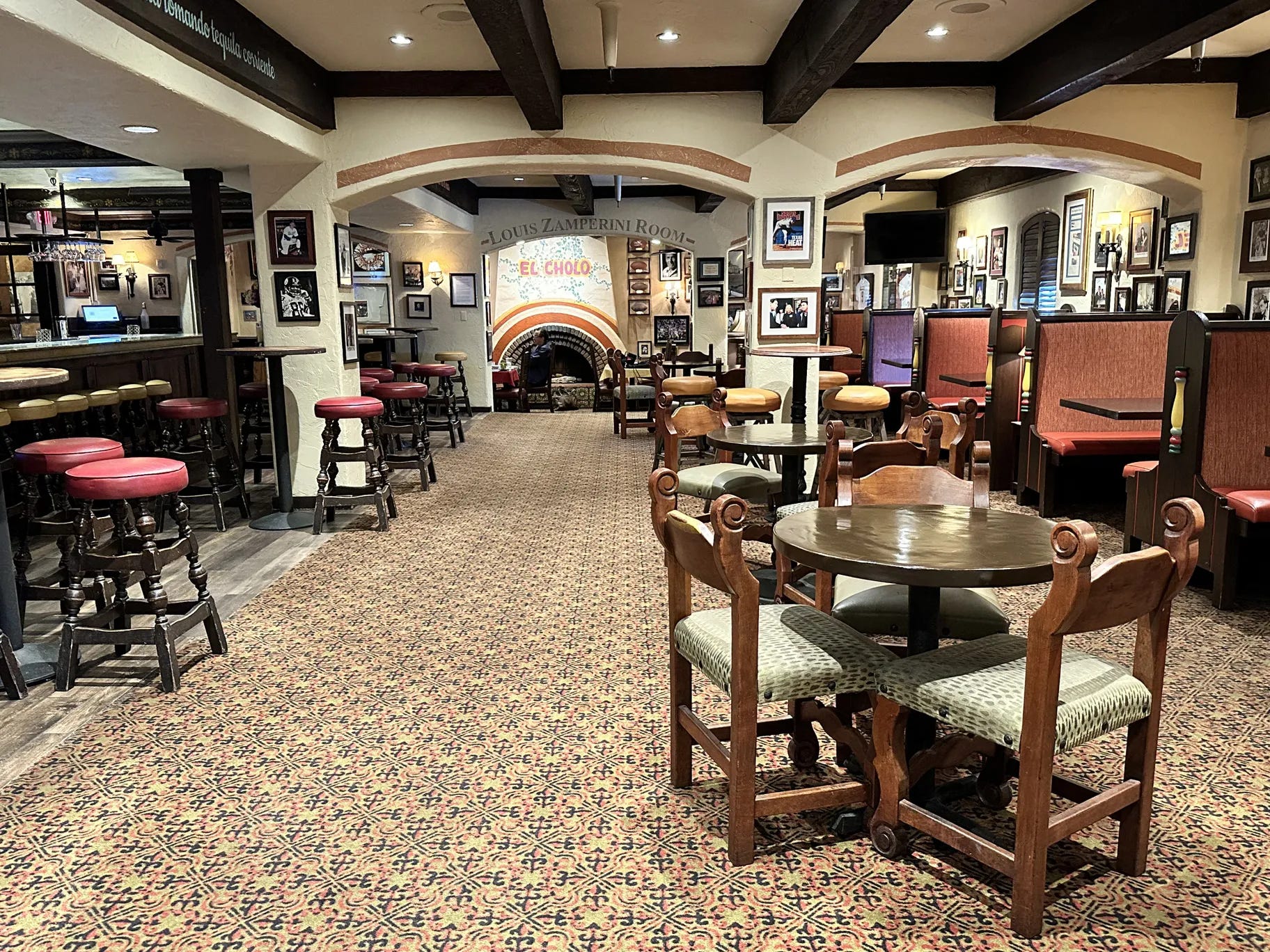
The University of Southern California sits just over 2 miles from the restaurant. The original location was even closer to the school, but the students followed when they took over the bungalow on Western Avenue in 1931. Photos of USC athletes “Paul Salata, hero of the 1945 Rose Bowl; Tom Seaver, a Trojan star in the 1960s before his Hall of Fame pitching career; Cheryl Miller, the basketball legend; and football players Matt Leinart, Reggie Bush, Anthony Davis, Keyshawn Johnson and Petros Papadakis” adorn the walls of the place today.
The biggest tribute to a Trojan at El Cholo is the Louis Zamperini Room, named after the USC track star and South Bay Los Angeles hero who insulted Hitler at the 1936 Berlin Olympics, survived 47 days adrift at sea, endured two years as a Japanese POW, and came home “unbroken”.
Faithful readers of this drivel understand I am a man of simple tastes. A part of the El Cholo feeling is finding comfort in simplicity.
The margaritas are strong and taste as they should, without flourish.
The housemade tortillas are thick and chewy, the sort of comfort food that keeps you coming back. The restaurant’s website tells the story of customers Kate and Lauren Wagman, who estimated that by the mid-90s, they had eaten 5,000 tortillas between them.
I am not a food reviewer. I write love letters to places in Los Angeles that I hope you’ll visit because I don’t want them forgotten. I could never be a food reviewer because I order the same thing whenever I go to a place. I usually just want cheese enchiladas smothered in red sauce in Mexican restaurants. Secretly, I compare them to every other red cheese enchilada I’ve ever had, but I would never write about that. At El Cholo however, if you visit during the warmer months, you may want to try the green corn tamales they are famous for. "El Cholo's cooks shuck fresh green corn, cut off the kernels, grind them, then whip the results with butter, cream and a dash of sugar…After adding in a bit of cornmeal, the ingredients are converted into a light, creamy mass — portions are then formed into six-inch-long fluffy mounds filled with aged, year-old, yellow cheddar cheese (which comes from a special farm in Wisconsin) and Ortega chiles."
One of the many cool things about El Cholo is that the menu gives the date the dish was added. You’ll learn that the Green Corn Tamales were originally from 1923, Carmen's Original Nachos in 1959, and the Crabmeat Enchilada was introduced in 1971. This fun fact is only marred by the erroneous inclusion of Fajitas in 1984. I implore the family to rethink this decision.
The family in question is the Salisburys. Alejandro and Rosa Borquez’s daughter, Aurelia, married Ron Salisbury in the late 20’s took over the restaurant, and their son, also Ron, runs the place today and has built an El Cholo empire of six locations.
The fortune teller may have done her job before all those years ago, even if no one can remember what she said.
"You’ll lose something you thought you needed."
“Memories carry a price.”
“This too shall pass.”
Life has changed, and our days of tailgates together and the big Mexican dinners that followed seem as distant as USC football championships. College football has become the NFL, and the idea of corralling a large group to wait for a table in today’s digital age seems quaint. Our fathers are gone now, too.
But El Cholo still stands. Calling us back and finding some version of ourselves that lived in that place in time.
Our memories of El Cholo may feel bittersweet. But more sweet than bitter. Sweetness in the memories of those long Saturdays we wished would never end. Of course, nothing ever feels like it did when we were kids, but I sure wish it did.
Go to El Cholo. Go during green corn tamale season if you can. Sit in a booth. Order a margarita. Maybe two. Whatever you’re carrying, it’ll pass.
I was there a couple months ago. Love it.
I have been waiting for this one.